
Stainless steel PTFE hose is a high-performance hose composed of a polytetrafluoroethylene (PTFE) inner tube and a stainless steel wire braided layer. It possesses excellent corrosion resistance, extremely low permeability, and oil resistance under high temperature and pressure, making it a high-performance fluid transport product suitable for harsh environments. It is widely used in industrial, chemical, automotive, machinery, and semiconductor fields.
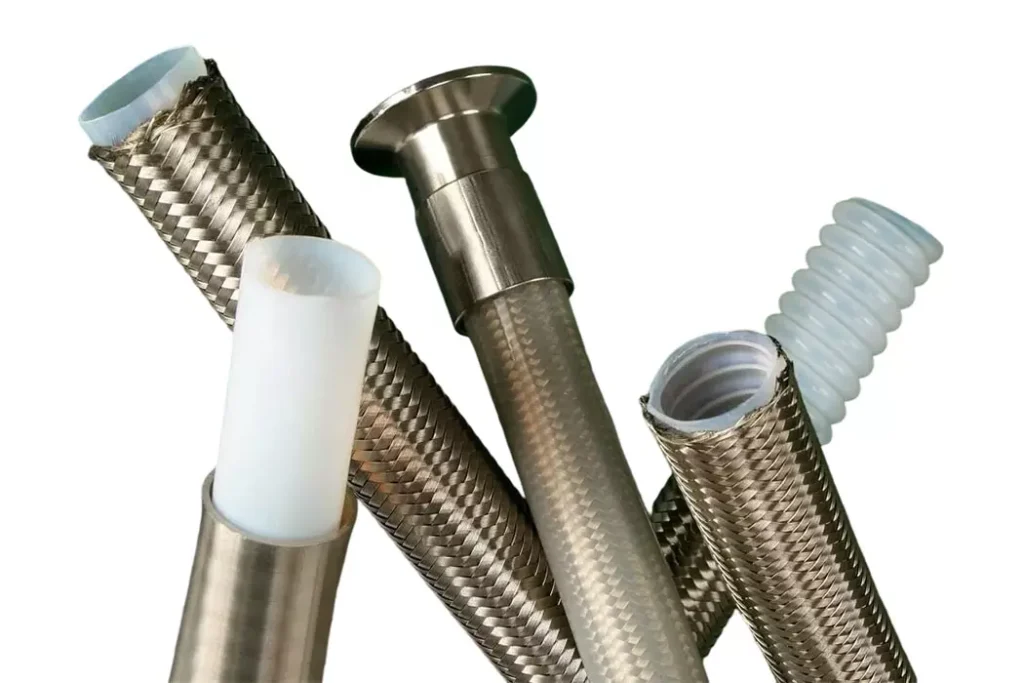
Structure of Stainless Steel PTFE Hose
A standard PTFE stainless steel braided hose consists of the following components:
- Inner Liner (PTFE)
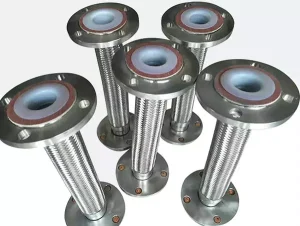
Used as pure PTFE or conductive (carbon-filled) PTFE, available in smooth inner wall or corrugated (spiral) structure. Provides corrosion resistance, low friction, and hygienic fluid transport performance.
- External Reinforcing Layer
Generally made of 304 or 316 stainless steel wire braid, providing pressure resistance, mechanical protection, and flexibility. Double braiding is also available to increase pressure rating.
- Outer Protective Layer (Optional)
- Silicone protective outer layer
- PVC/PE protective layer
- Fire-retardant fiberglass sleeve
Enhances abrasion resistance and environmental protection.
- Can be equipped with fittings to form hose assemblies
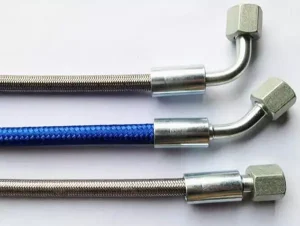
Strongflex offers complete PTFE hose assemblies, including a variety of fittings:
- Stainless steel fittings (304/316)
- JIC, NPT, BSP, BSPT, ORFS, Metric, SAE, Flange
- Crimp or reusable fittings
- Straight-through, 45°, 90° and custom angle fittings
Key Features of PTFE Stainless Steel Braided Hoses
- High Temperature Resistance: The stainless steel PTFE hose can operate normally at temperatures up to 250℃, and some models support a steam pressure of 10 kg/cm².
- Corrosion Resistance: The PTFE inner tube is chemically inert and resists corrosion from strong acids, strong alkalis, and organic solvents, making it suitable for highly corrosive environments.
- Extremely Low Permeability: The PTFE lining has extremely low gas and liquid permeability, ensuring the purity and non-contamination of sensitive media.
- Non-stick Properties: The PTFE inner wall is very smooth, making it difficult for media to remain and easy to clean, suitable for hygienic or cleanroom-grade delivery systems.
- High Pressure Capacity: The outer stainless steel braided layer provides excellent pressure resistance, suitable for medium and high pressure systems.
- Flame Retardant: PTFE is naturally flame-retardant and does not produce toxic fumes when exposed to high temperatures.
PTFE Stainless Steel Hose Technical Specifications
- Inner diameter range: 1/8”-2”
- PTFE stainless steel braided hose temperature range: -70°C to +260°C (-94°F to +500°F). Specific temperatures depend on hose construction and fitting type.
- Pressure range: Up to 270 Bar (approximately 27 MPa)
- Flexibility: Bending radius is 3-6 times the pipe diameter, with a maximum bending radius of up to 3 times.
- Weight: Approximately 500 grams for a 2-meter hose, lightweight design.
- Long Service Life: Chemically inert material, no aging or deformation with long-term use.
- High Customizability: With the addition of carbon black or nano-conductive materials, suitable for the electronics and semiconductor industries. Alternatively, using FDA-compliant materials and manufacturing processes, suitable for the food and pharmaceutical industries.
- Multiple Structures:The inner PTFE material can be customized to produce smooth or corrugated shapes. The outer stainless steel braided layer can be made of 304 or 316 stainless steel, and the number of braided layers can be multi-layered or single-layered depending on the application.
Applications of Stainless Steel Braided PTFE Hoses
Stainless steel braided PTFE hoses are widely used in industries requiring high purity, high temperature strength, and strong corrosion resistance. These include defense, aerospace, electronics, electrical engineering, chemical engineering, machinery, instrumentation, textiles, metal surface treatment, pharmaceuticals, medical applications, food processing, and metallurgical smelting.
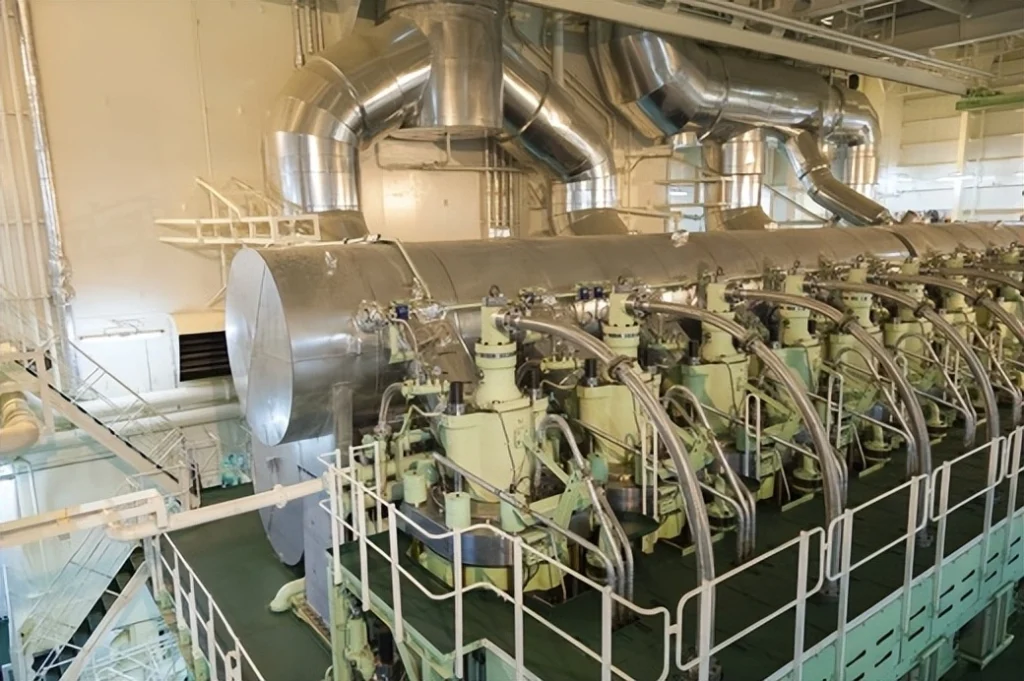
Chemical and Industrial Applications: Used for conveying highly corrosive media or high-temperature, high-pressure steam, commonly found in industries such as machinery and military.
Food and Medical Industry: Used for conveying high-purity media or food and pharmaceutical products such as beverages.
Automotive and Racing: Serves as fuel lines, brake lines, turbocharger oil inlet/outlet pipes, and power steering hoses in automobiles.
Machinery Manufacturing Industry: Widely used in hydraulic and pneumatic systems.
Aerospace Industry: Braided reinforced Teflon hoses are also commonly used in aircraft fuel systems, hydraulic systems, and pneumatic systems to meet their stringent requirements for reliability and weather resistance.
Main Classifications of Stainless Steel PTFE Hoses
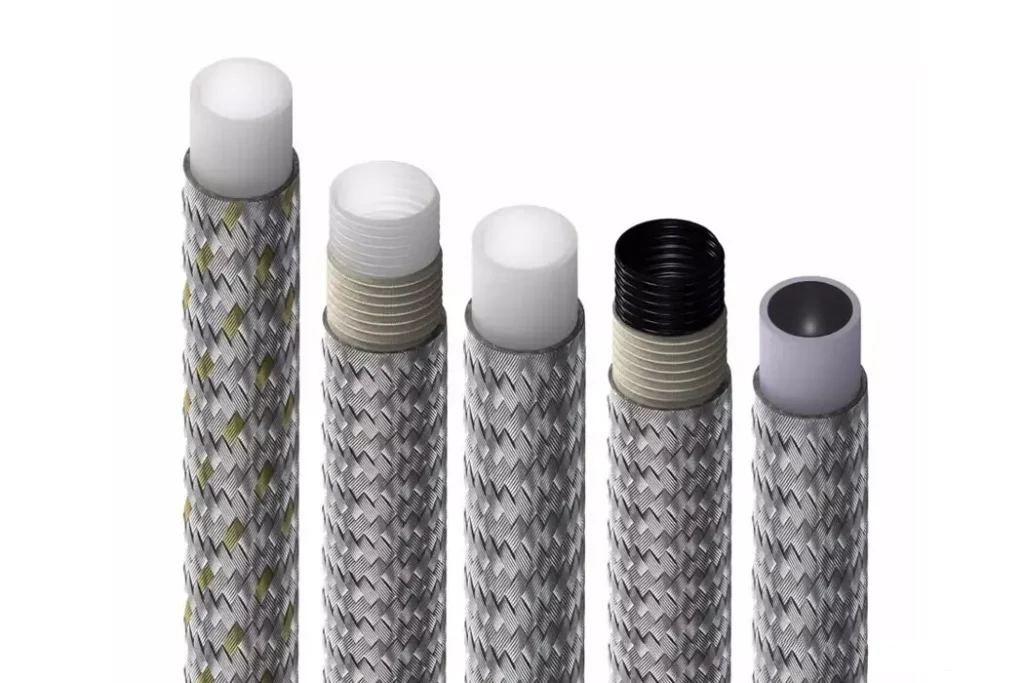
Unreinforced Teflon Hose
This type of hose consists solely of a Teflon tube without an external reinforcing layer. It possesses the purest Teflon material properties, such as excellent corrosion resistance, non-stick properties, and high-temperature resistance. However, due to the lack of a reinforcing layer, its compressive strength and tensile strength are relatively weak, typically limiting its use to low-pressure or unpressurized environments.
Primarily used in applications requiring extremely high corrosion resistance but with relatively low operating pressure. Examples include chemical reagent transportation in laboratories, sanitary piping in the food industry (such as for conveying viscous sauces and juices), pharmaceutical liquid transportation, and some special electrical insulation applications.
Smooth Bore PTFE Braided Hose
The inner layer is made of smooth Teflon tubing, with one or more layers of reinforcing material braided from stainless steel wire, nickel alloy wire, or other high-strength materials. This structure gives the hose high compressive strength and tensile strength while maintaining the corrosion resistance and high-temperature resistance of Teflon. The braided reinforcement layer also effectively resists bending and torsional stresses, giving the hose good flexibility and stability in complex installation environments.
Widely used in industrial applications requiring high pressure and harsh operating conditions.
Corrugated/Spiral PTFE Braided Hose
The inner Teflon tubing features a corrugated structure, which gives the hose greater flexibility and bending resistance, allowing it to operate with a smaller bending radius while also providing some vibration absorption and displacement compensation. While the pressure resistance of corrugated Teflon hoses is slightly lower than that of braided reinforced hoses, they offer significant advantages in applications requiring frequent bending or large displacement compensation. Suitable for applications involving frequent movement, bending, or vibration.
Anti-Static/Conductive PTFE Hose
Conductive PTFE hoses are made by adding conductive components or using special processes to give PTFE (Teflon) hoses a certain degree of conductivity. These hoses are particularly useful in applications where static electricity needs to be dissipated. For example, in the chemical industry, when transporting flammable and explosive liquids that easily generate static electricity, conductive PTFE hoses can quickly dissipate static electricity, preventing the accumulation of static and potential hazards.
Non-conductive PTFE hoses
Non-conductive PTFE hoses retain the excellent insulating properties of PTFE and are non-conductive. They are particularly important in scenarios where conductivity is not required, or even where preventing current flow is essential. For example, in the electronics industry, when transporting electrostatically sensitive electronic components, non-conductive PTFE hoses can prevent current from damaging the components, ensuring their quality and performance.
Food-grade and FDA-compliant PTFE hoses
These hoses prioritize hygiene and safety. The Teflon material used must meet food-grade or pharmaceutical-grade standards to ensure no contamination when transporting food, medicine, or other media. The hose’s smooth, non-stick inner wall facilitates cleaning and disinfection, meeting stringent hygiene requirements.
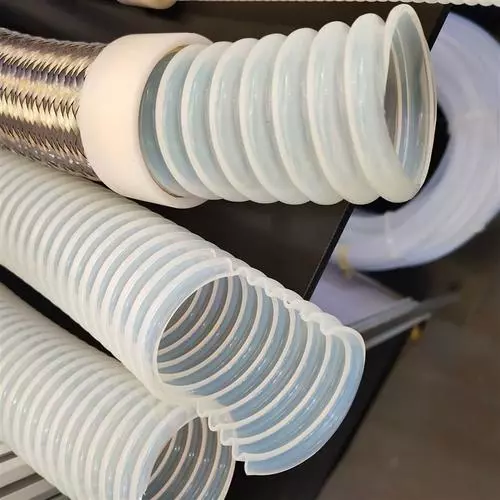
PTFE Hoses and Fittings
PTFE hoses can be connected to virtually any type of fitting, with no limitations on system connection methods. The hose ends are compatible with various fittings because the core is PTFE, allowing for connection with fittings of different materials. The outer layer is a stainless steel braided layer, enabling various forms of mechanical locking. It is compatible with standard industrial fittings such as flanges, threads, and camlocks, as well as BSP, NPT, Metric, JIC threaded, AN fittings used in high-pressure eluents. It has a wide range of applications, is corrosion-resistant, and high-temperature resistant. Even in the food and pharmaceutical chemical industries, it can be connected to appropriate sanitary fittings such as DIN 11851, SMS, RJT, IDF, and Tri-Clamp. Furthermore, it offers a high degree of customization.
Fittings and ferrules for PTFE hoses are made of galvanized carbon steel, 304 and 316 stainless steel, polypropylene, or other materials.
Frequently Asked Questions
What are the differences between SAE100 R14 and stainless steel PTFE hoses?
Although both SAE 100R14 and stainless steel PTFE hoses use PTFE as the inner lining and are wrapped in stainless steel braided hose, they differ significantly in standards, applications, and pressure ratings.
SAE100R14 explicitly complies with the SAE 517 standard and is a standardized PTFE hydraulic hose, commonly used in hydraulic systems requiring high pressure, high temperature, and chemical corrosion resistance.
However, stainless steel braided PTFE hoses are only a structure description and lack a clear standard. They can be customized in size, wall thickness, pressure, and outer diameter according to customer needs, and are mostly used for general industrial fluid transport or ordinary chemical applications, but are not suitable for scenarios with strict hydraulic standards.
Furthermore, the compatible fittings are different. SAE R14 is only compatible with SAE R14 specific fittings such as the 00TFO ferrule, while PTFE stainless steel braided hoses can use any industrial fitting.
What are the differences between PTFE hoses and ordinary rubber hoses?
The most significant difference between PTFE hoses and ordinary rubber hoses lies in their material properties and applicable operating conditions.
PTFE hoses possess extremely high chemical inertness and high-temperature resistance. Combined with braided stainless steel, they can withstand high pressure. Their smooth inner wall prevents media absorption, making them ideal for chemical, pharmaceutical, food, and high-temperature, high-pressure liquid transportation.
While ordinary rubber hoses are flexible and inexpensive, their temperature resistance, chemical corrosion resistance, and pressure resistance are limited, making them primarily suitable for low-pressure, normal-temperature, and general industrial fluid transportation.
What is the difference between smooth bore and corrugated bore PTFE hoses?
Smooth bore PTFE hoses have a completely smooth inner wall, as flat as a cylinder, and are commonly used in applications requiring high pressure and high flow rates.
Corrugated bore PTFE hoses have a spiral or corrugated inner wall, resulting in a smaller bending radius, making them more suitable for low-pressure environments with repeated movement or vibration.
What temperature can stainless steel PTFE hoses withstand?
Stainless steel PTFE hoses offer one of the widest operating temperature ranges in the industry, enabling stable operation in extreme high and low temperature environments.
Standard operating temperature range: -70°C to +260°C (-94°F to +500°F)
What pressure can stainless steel PTFE hoses withstand? Are they safe for high-pressure applications?
Stainless steel braided PTFE hoses have excellent pressure resistance, the specific pressure they can withstand depends on the hose’s structure, size, number of braids, etc.
| Hose Structure | Withstandable Working Pressure |
| Smooth Bore PTFE + + Single-Layer Braid Stainless Steel | 58bar-280bar(1/8”-1” Inner Diameter) |
| Smooth Bore + Double-Layer Braid Stainless Steel | 200–500 bar |
| Convoluted PTFE + Braid Stainless Steel | 20–183 bar(1/8”-1” Inner Diameter) |
Each hose has a rated working pressure and burst pressure after production. Please confirm the system pressure rating before selection to ensure that the hose’s pressure range is higher than the system pressure.
Can stainless steel braided PTFE hoses transport gasoline, diesel, and ethanol?
Yes. Stainless steel braided PTFE (polytetrafluoroethylene) hoses have extremely high compatibility with a variety of fuels and chemicals, making them widely used in automotive, racing, industrial, and fluid delivery systems.
Can braided PTFE hoses be used for food-grade or pharmaceutical delivery? Are they safe?
If the hose meets food or pharmaceutical standards, such as FDA or USP Class VI certification, braided PTFE hoses are perfectly suitable for food-grade or pharmaceutical delivery and are among the safest and most stable hose materials in the industry.
Can PTFE hoses be customized? What is the minimum order quantity?
PTFE hoses can be customized in length (50m/100m per roll, depending on size and structure), inner and outer diameters, inner lining material (standard, smooth inner wall, corrugated inner wall, conductive/non-conductive), braided outer layer (single-layer stainless steel braid, double-layer stainless steel braid, nylon braid, etc.), and connection type, etc.
The minimum order quantity is 500m. Larger quantities of hoses will receive more favorable pricing.
How to choose a high-quality stainless steel PTFE hose supplier?
First, determine the product’s quality, including durability, corrosion resistance, and hose structure. Second, ensure the product parameters meet requirements, including minimum bending radius, pressure rating, and temperature rating. Then, review the manufacturer’s production standards and certifications, and consider customer reviews and industry experience. Finally, comprehensively consider cost and after-sales service.
Tom is a professional hose manufacturer using high-quality PTFE and stainless steel wire raw materials to ensure excellent chemical inertness and low permeability of the inner tube, temperature and pressure resistance of hose, making it suitable for transporting various media.
We offer one-stop customization services, including hose structure materials and hose fittings types, providing complete hose assembly solution suitable for various industries and applications. We employ strict quality control during production, conducting a complete quality inspection process before shipment to ensure that every hose meets high standards. Each batch of products comes with a traceability ID card and test report, and we ship on time. We take 100% responsibility for any problems found after receiving the product, providing worry-free after-sales service.
Stainless Steel PTFE Hose - Tom Rubber Hose
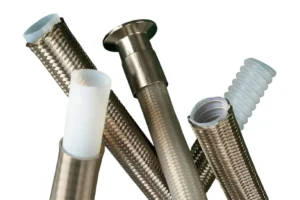
Stainless steel PTFE hose is a high-performance hose composed of a polytetrafluoroethylene (PTFE) inner tube and a stainless steel wire braided layer. It possesses excellent corrosion resistance, extremely low permeability, and oil resistance under high temperature and pressure, making it a high-performance fluid transport product suitable for harsh environments. It is widely used in industrial, chemical, automotive, machinery, and semiconductor fields.
Marque du produit: Tom Industrial Hydraulic Hose
5
 EN
EN  RU
RU  AR
AR  EN_AU
EN_AU  VI
VI  PL
PL  PA
PA  ID
ID  EN_GB
EN_GB  ES
ES  ES_VE
ES_VE  FR
FR